


The Sense of Me
Rayotta Aug 27, 2022
The other day I was reading the book, Deep Learning With
PyTorch, when I bumped into the word "self-awareness". I never really
understood the word, so I gave it another try.
Basically, it's the state of being aware of the fact that
I am an individual person, with individual brain functions, like feeling,
memory, thinking and judgment. Consequently, I have my own goal to
achieve, my own happiness to pursuit, and my own choices to
make, in order to further ensure the first two.
That's already pretty clear, but some confusion remains. First one is
certainly the details of this concept. To begin with, self-awareness is
a perspective of objective existence, a comprehension of one's identity, personality
and individuality. It then can be reasoned as a branch of
cognition, thus a task of epistemology. Presumably, I can use conceptual
cognition (see this article in Python section), to label my identity, personality and individuality as instances of
some classes, then the behavior and outcome of other instances in
the same classes could be valuable. Again, this requires my thorough
understanding of myself, to give myself the correct labels. All in
all, it's a result of rational thinking, an exclusive function of
relatively complex brains (thus a human being would probably be happy
to do it).
Its fundamental idea is that a person is the entity observing,
but separated from, his/her own mind. Here, the self is viewed
as an object, for only then can it be observed and
evaluated, as the so-defined "objective self-awareness" is what I'm really interested
in. Its aim is to gain information about oneself, some knowledge
to understand one's motives, desires, thinking patterns, strengths and weakness, to
better control oneself by making use of surrounding entities and avoiding
possible dangers, for the purpose of better achieving one's goal.
Max said to herself in EP.4, "I need to navigate the
present without messing up the past." This is a good confirmation
of her self-awareness, even though it seems that she didn't realize
it then. For me, since I don't have any rewind power,
my past is pretty much fixed, so the "messing up the
past" part is not my concern. But the "navigate the present"
part tells me exactly what I need to do. Because my
actions in present is what navigate my future, and I want
my future self to really appreciate the navigation I do now.
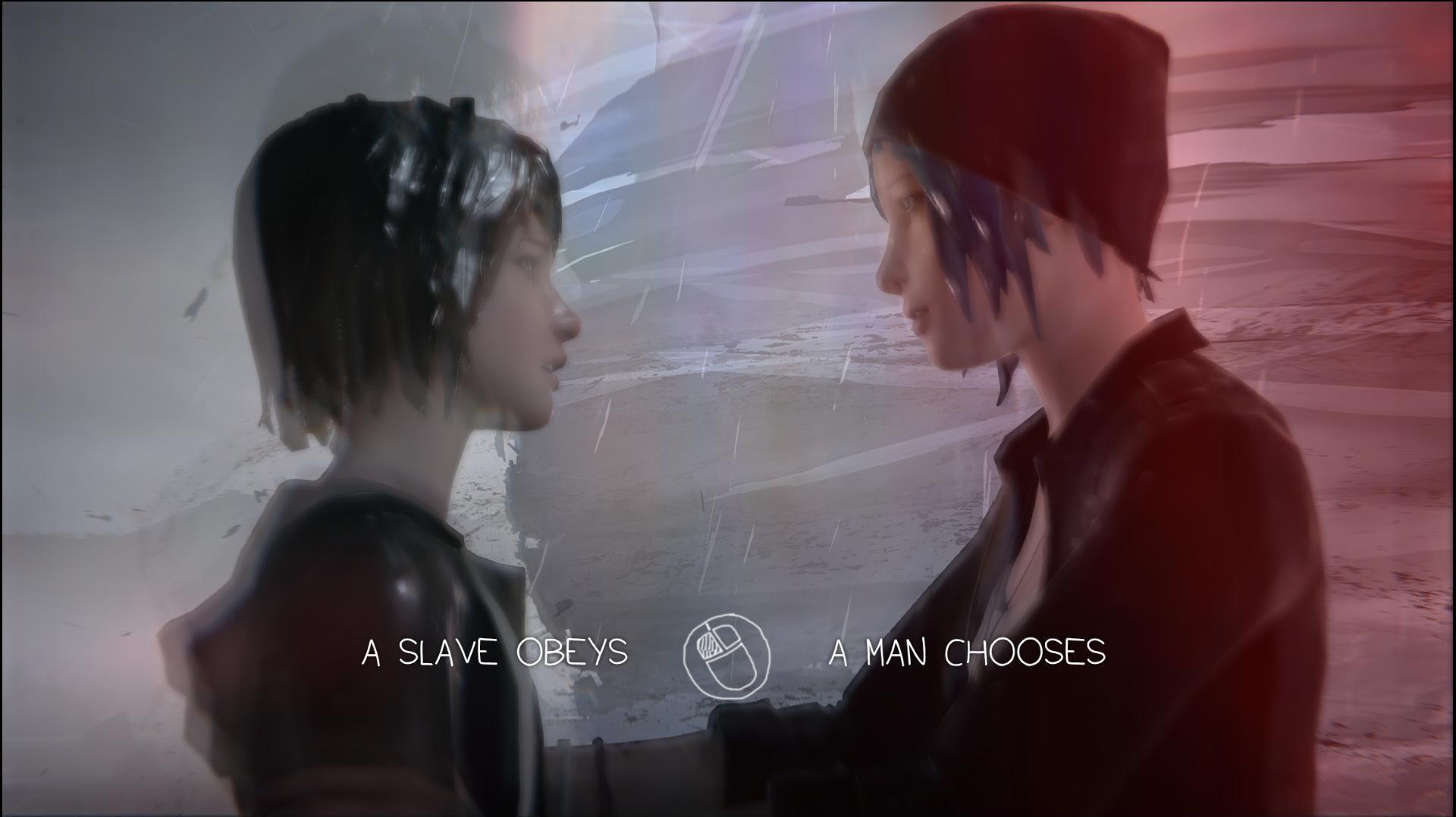
Another confusion is the order of priority. Max said to Chloe,
"you are my number one priority now", in a situation where
she had to choose. That's the critical point, where the importance
of Max's order of priority really showed itself. When I heard
the words, another sentence came into my mind. "A man chooses.
A slave obeys."
It's obvious through the story of the five days, that Chloe
is much more in line with Max's self-awareness. She is the
one to make Max reach her true self, and let go
of the uniform she usually hides in, away from other people.
To Max, Chloe is the goal above all, the hope to
know her true self, and the happiness that no other things
could bring. If Max really sees Chloe as the "first priority",
which in fact is seeing her self-awareness as the first priority,
her choice is clear. The question here is in fact "should
I put my self-awareness on top of all things?" It's a
question for Max, but also for everyone.
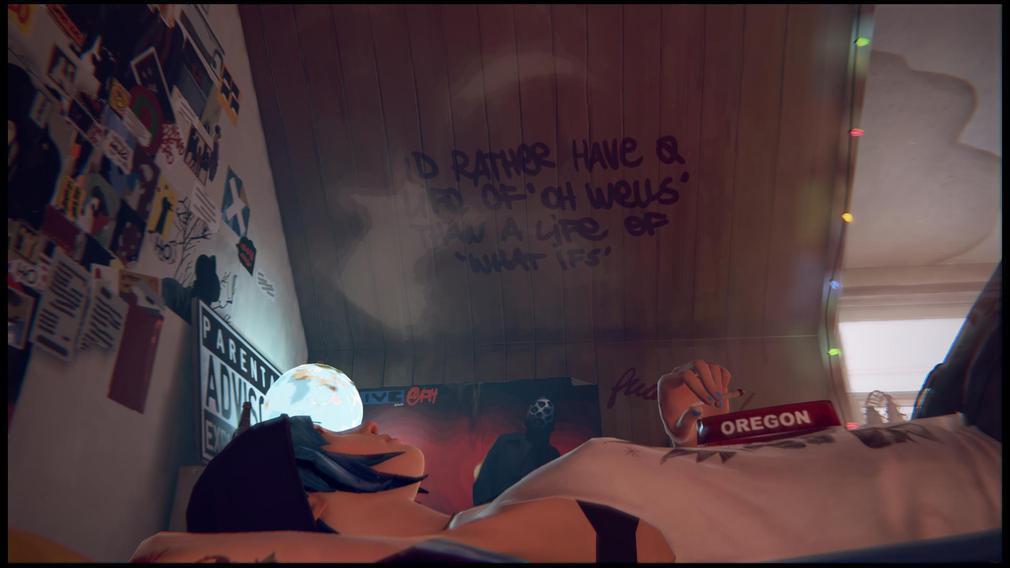
And the answer here, mine is obviously "yes", but what about
the game? It's in Chloe's graffiti, "I'd rather have a life
of 'oh wells' than a life of 'what ifs'." At the
end of my life, I hope I can smile upon it,
knowing that I'm proud of what I've done, without leaving any
regrets. Like Chloe, I'd also like to say an "oh well"
to myself, rather than a "what if".
A third confusion is the interaction with other people. Frankly, now
that I've given a thorough thought about the previous questions, this
one is not confusing anymore. But it was before, so I
might as well say something about it.
I once helped a friend for his homework about social psychology,
which gave me some clues. People are compliant. (Most of them.)
They tend to follow the flow of things, and are easy
to be influenced by others around them, which could be dangerous
to their self-awareness, should this trait be abused by some malicious
people, or overflowed simply because of the lack of independence, or
knowing themself and their true desires. More often than not people
do things according to the society they were raised in. Very
seldom can their thoughts and actions surpass their circumstances. And the
things they do in turn inspire or stimulate other people. This
way people in a society is enhanced or trapped by it,
knowing it or not.
The answer to this question is in the quote of George
Bernard Shaw, again, "the people who get on in this world
are the people who get up and look for the circumstances
they want, and if they can't find them, make them." I
must choose the circumstances, including people, around me, in order to
gain benefits and helps from them, to better pursuit my goal.
Or, if some things are beyond my choice, the least I
can do is selecting what aspect I need from them, and
what I should beware. Again, here's the quote from "All Wounds" , "Choice, that's the real power."
I must note, that everybody has the same level of cognition
as I do. (I'm not sure but that's default.) I pursuit
my goal as my self-awareness directs me, so does everybody else.
I must not offend others' mind, as I don't surrender my
mind to anyone else. If a person demands others to bend
to his own goal, well, I think everybody knows what to
do.
So basically, this sums up the first reason why I cherish
this game so much. It sent me a strong message, not
by setting an explicit boss figure, or disastrous event, to fight
against, because that would be mediocre. Instead, the final enemy is
actually my hypocrisy and fake compassion, and it's often the toughest to conquer because
when someone is taught from very early age to be kind
and unselfish one often forgets the thing that is the most
important. One might give up self-awareness, and do some other things
set up by the society or culture to be the paragon
of virtue, assuming that by doing those one would achieve the
ultimate happiness, and be praised by generation after generation. Only problem
here, is that one doesn't need to be a paragon. One
just needs to be oneself. That's exactly the message LiS sent
me, in such a subtle but swift manner. (The nightmare scene,
to name the most impressive one. I need another article for
that.) That's powerful and clever, and I'm so glad I get
it.
All in all, these are all the things the song "The
Sense of Me" trying to tell me. To hear myself again
from time to time, is something worth trying, and trying again.
--------------------------------------------------------------------------------
On a completely irrelevant side note, I've read some articles on
objective self-awareness. The rough idea is that objective self-awareness is an
automatic process of self-evaluation, a comparison between self and standards, as
defined as a mental representation of correct behavior, attitudes, traits, and
so on (from plenty of science, art, culture, and such forth,
focusing on external world). If a discrepancy is found, people would
either actively change themselves to be more congruent with the standard,
or avoid the self-evaluation which effectively terminates self-awareness.
That confirms what I said in the last article, Anniversary, that Max needs to learn some real physics, from a
competent teacher or some reliable sources. She really needs to know
what correctness is, not some emotions. Optionally, she could also learn
some ethics, to understand the consequence of discrepancy between natural laws
and moral assertions. Otherwise, given her rewind power, it's hard to
imagine what she would to the world, or to herself.
--------------------------------------------------------------------------------
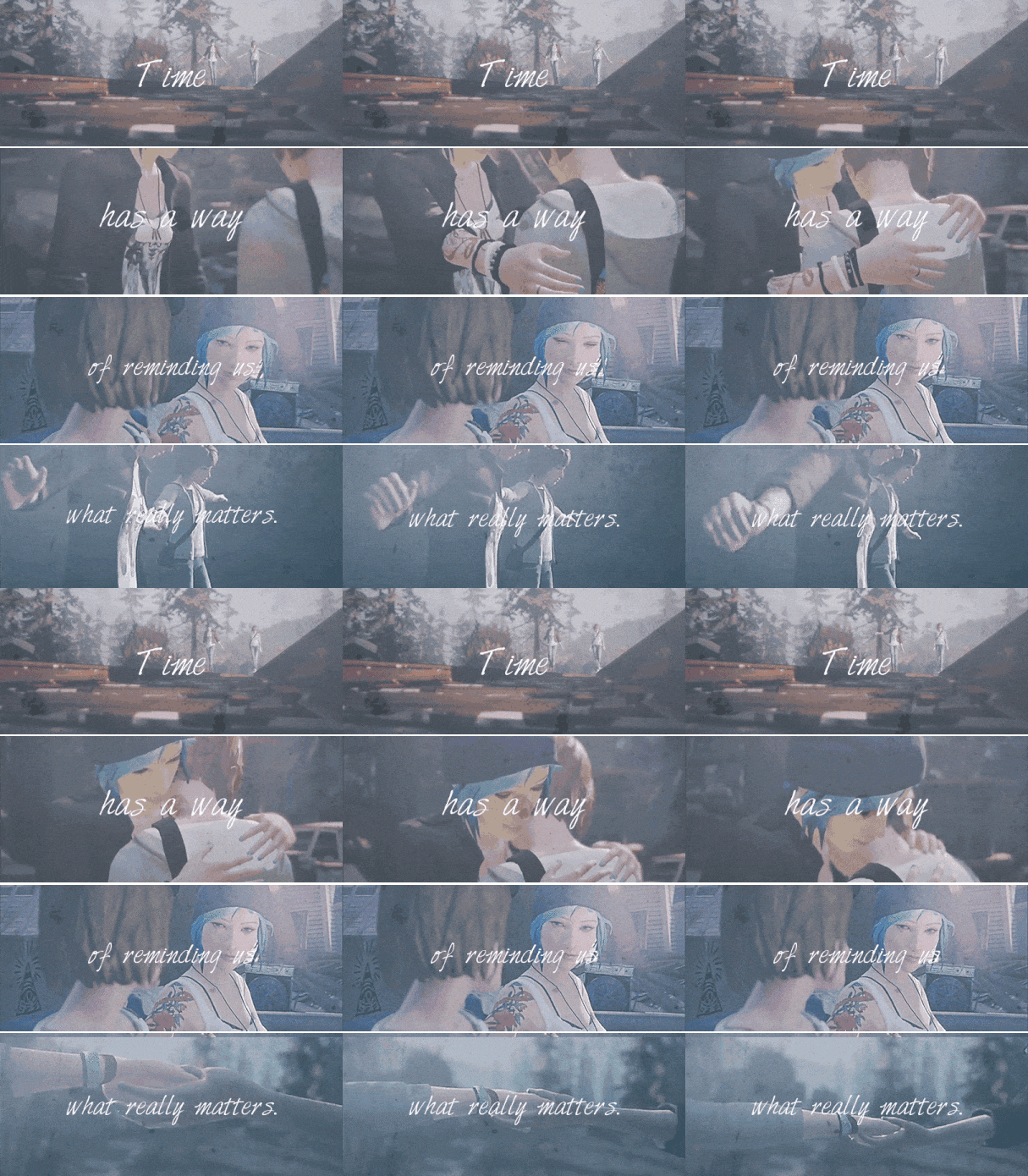
Here's a gif that conveys the same message. Created by Elfkisser.
Big thanks to you!

0 people liked this.




- @Rayotta Author