
Anniversary
Rayotta Jan 5, 2021
I wrote this article in July 2018 after a year of
playing Life is Strange, and I needed to write down some of my ideas
during that time. So here it is. Any suggestions are welcome.
1. On Right/Wrong And Good/Evil
"Right" and "wrong" are the terms to describe whether a piece
of understanding is accurate to its corresponding objective fact. Whether this
piece of understanding is right or wrong is utterly decided by
the objective reality itself. "Good" and "evil" are descriptive words of
the attitude held by an individual or a community towards an
event or object. This description is usually dependent on this perceiving
subject's surroundings, experience, traditions, and/or other possible influences. If I only
want the guidance from objective reality, I need only to pay
attention to "right" or "wrong", and be a pure bystander as
to the issue of "good" or "evil". As Bertrand Russell said,
"When you are studying any matter, or considering any philosophy, ask
yourself only what are the facts, and what is the truth
that the facts bear out. Never let yourself be diverted, either
by what you wish to believe, or by what you think
would have beneficent social effects if it were believed. But look
only and solely at what are the facts."
Objective reality is defined as the existent facts that are consistent,
independent from a subject's perception. For example, mankind evolved to its
current form about a million years ago, before that the nature
is an example of objective reality. Also, there are the scientific
facts. A fact described by a scientific law (after confirmed) is
existed throughout history and in every location, while people at that
place at that time have possibly not yet discovered it.
2. On Fate
Since this "fate" theory is not logically verifiable, this hypothesis is
highly questionable to me. I personally see it as a temporary
solution when we cannot make clear of something within the current
level of knowledge, and this temporary solution could not and should
not be considered as a factor in any decisions I need
to make, if I only want the guidance from objective reality.
So far I can conclude that "fate" is the comprehensive result
of previous choices made by self or other people around, not
a series of tasks arranged by a supreme entity. So there's
in fact no such thing as "fate". Other people make their
choices, so do I. I made choices in the past, so
do I in the present. No need for anybody to see
previous choices or others' choices as tenets, and bend the will
of present self.
3. On Choices
Everything is a choice, including "fate", therefore I need to make
my own decisions, according to my own will, in everything that
I'm involved. This feature that every person needs to make own
decisions according to their will, is the meaning of the concept
"freedom". To quote the general idea of Jean-Jacques Rousseau, that freedom
is the nature of man, and that people in the state
of nature were innocent and at their best and they were
corrupted by the unnaturalness of civilization, "he is everywhere in chains".
Although I do not completely agree with his idea that "freedom
is the nature of man" - I think the term "nature"
here means "necessary and sufficient condition", therefore the nature of man
is reason - still I think that freedom is an inevitable
choice of a reasonable man, or striving for freedom is an
inevitable result of reason, or a necessary condition of it. Surrender
to the loss of freedom is a symptom caused by the
loss of reason, which further means the loss of human nature.
That being said, if Max wants to live in the fullest
sense of a human being, she must carry out her nature,
meaning she must make her own choices, completely and independently, according
to her own free will, to escape from the chains of
society, and to become a whole and complete human being. That's
why I very much appreciate that in the novel All Wounds Max keeps saying to Chloe, and to herself, that "we need
to be whole". That's also the part that I think is
the most brilliant idea of DONTNOD, to tell everyone that he/she
must make own choices freely, without any restrictions from any other
people, if this person truly wants him/herself to be free.
That's why I love the song Mountains so much, and the
lyrics that say "we could run away". Maybe only by running
away can a person get rid of all the chains of
a society, and find his or her true self, and reach
freedom. I once read a reply in a Chinese forum, that
said "To save the town is in accordance with sociality. To
save Chloe is human nature." Well said. If a society requires
that the individuals in it have to lose their nature, it's
strongly not recommended to stay in it for long time. So
it seems that the "Galt Valley" in Atlas Shrugged may be
the ideal place to live. (Note here, the difference between a
society trying to override human nature, and a society enhancing it)
However, when all has been said, we should not neglect the
fact that to run away is so difficult that few people
can really achieve that. Rousseau said that "the unnaturalness of civilization"
is irreparable. Henry David Thoreau only lived by the lake far away from
people for two years. And it can only be a delusion
for the mountains to run away. In the final scene of
the game, the view that Max and Chloe drove out of
town was no doubt true happiness, although clearly they were to
endure a lot of difficulties. But no matter what difficulty lies
ahead, I should never forget that happiness is always the more
the better. I should try to grasp it with all my
strength, whenever I can. Even if it is not everlasting, I
have no reason to give it up. "Don't you think that
it's better to be extremely happy for a short while, even
if you lose it, than to be just okay for your
whole life?" (The Time Traveler's Wife by Audrey Niffenegger) "Happiness is
nonetheless true happiness because it must come to an end." (Bertrand
Russell) What I can say for now, the process of fighting
for happiness is usually much more enjoyable than a happy ending
itself.
That's also why I got so thrilled every time I successfully
saved Chloe. Max was somehow granted with this power, with which
she can better achieve her purpose and further go along with
her nature, thus becomes more of a whole and complete human
being. This process is the greatest appreciation she can get for
herself. So the final choice in game is not troublesome at
all. Of course Max should not give up her purpose and
nature. The two options are not comparable. One means to become
her own person, the other to become a slave of other
people. "A man chooses. A slave obeys." (Andrew Ryan in Bioshock)
If a person loses own purpose and nature, what remains is
merely a pile of organics.
4. On Survival
The reason why many people get stuck in the final choice
is probably that the act of saving Chloe is ostensibly the
cause of many deaths. This can be interpreted as a behavior
of associating evil, thus makes this choice seems tearing. Despite the
wish of the two having a life together, many people have
to let go. Admittedly, for a random somebody, the value of
all the people in Arcadia is greater than that of Chloe.
As Chloe herself said, there were too many people not deserve
to die, like Joyce. However, the truth can't be ignored here
is that the one who's going to make the choice is
not "a random somebody". For Max, Chloe is the one who
brings happiness, way more than other people can ever do. Therefore
the value of Chloe is greater than others.
There is no objective, constant assignment of an object's value for
all human beings. The amount of this object's value is varied
with each individual, or is utterly subjective. Value is defined as
the property of an object being important, or helpful, or beneficial
to a perceiving subject (usually a person or a community), or
the degree of this property. This definition requires a prior condition,
"a perceiving subject". If such subject is not present, this concept
is a pseudo term. So it can be derived that if
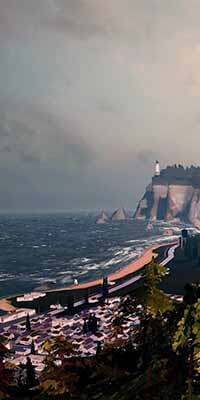
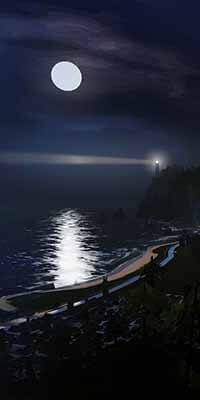
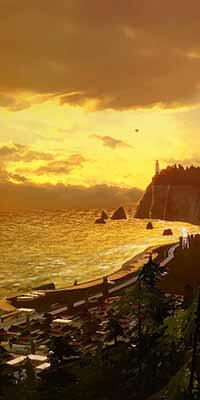
someone else was standing at bottom of the lighthouse at that
moment, he/she might choose differently, depending on this person's demand for
either of the two groups. But the fact is that it's
Max who was standing there, and it's clear that she needs
Chloe more.
I read some statements before, that Chloe's death is "the inevitable
result of twisting a normal timeline" and "a well-deserved outcome after
many faults", and that "Chloe should not live". My opinion here
is, whether a person should live utterly depends on whether this
person is capable to win life (solely or cooperatively), and whether
this person has made the choices helpful for survival, although to
survive may not be the intention of these decisions. In the
world of objective reality, a key point does exist indicating the
pattern of life and death for every human being (and other
creatures), which is "survival of the fittest". Other than that, any
statement or practice intending to meddle in the issue of life
and death is a wishful thinking, an override of natural laws.
An objective nature needs only the self-contained individuals working on their
own outstanding states, not the justice warriors that speak for the
nature in the name of righteousness. For example, Bertrand Russell's Nobel Prize speech in 1950 , in which he indicated that, in the face of objective
nature, any artificial moral criterion standing separately is in vain. What
we should really focus on is the driven effect of one's
desire to his actions, rather than to grant him a moral
code that we think is noble and expect his constant compliance.
Another example is the outcome of a natural disaster. In all
such events there are people survived and people died. It is
not by being "good" that some people can keep alive, but
because of the possible facts that they run faster, or jump
higher, or are more knowledgeable about survival, or someone else is
willing to help (as Max to Chloe), or they are just
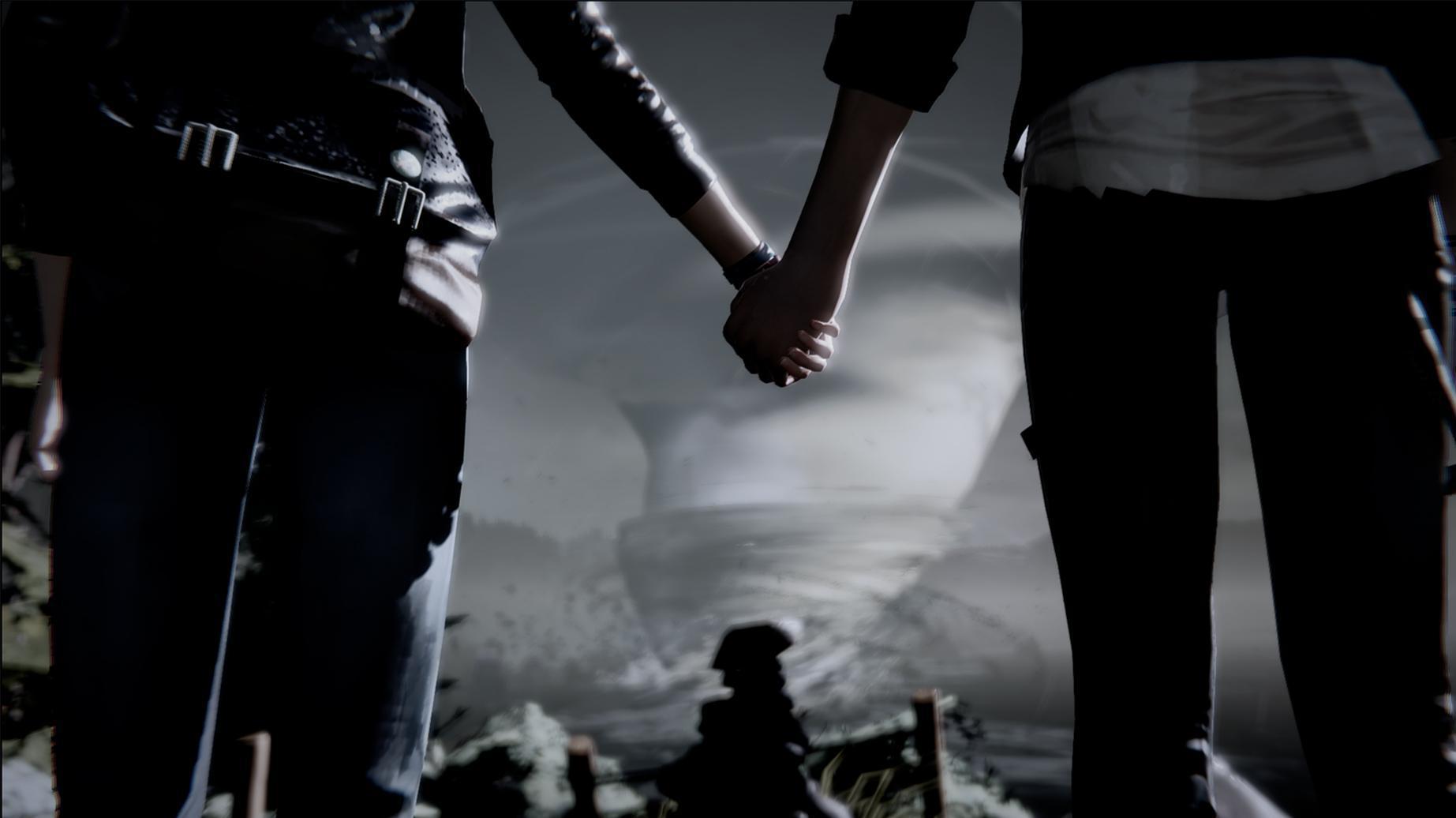
lucky. A third example is that, after Max saved Chloe and
they drove away, there were some deer loitering on the road.
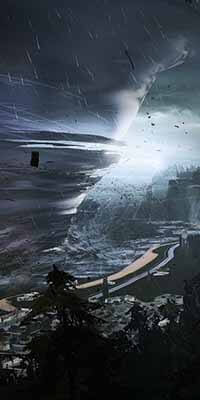
Being in a spot of frequent tornado incidents (which we can
conclude from Chloe's word at the end of Episode One, that
Oregon gets about five tornadoes every 20 years), residents there actually
don't have sufficient knowledge or experience or skill to survive, poorer
than some deer?
The phrase, "normal timeline", is an utterly subjective perspective. We have
experienced only one timeline, and if we call it "normal", that
makes us no different than frogs at the bottom of a
well. For what I know for now, there is no theory
or evidence that can prove the current timeline should not be
twisted. It is merely a piece of common sense, and common
sense is the collection of prejudices acquired from life experience (more
often than not from the life before age eighteen, said Albert
Einstein). Tying oneself to the condition where there's only one timeline
in a world where time travel happens, is just like sticking
in the bottom of a well when already aware of the
much larger world outside.
5. On Chaos Theory
This is a theory that says the states of a dynamical
system, which appear to be random and irregular, are actually governed
by deterministic laws that are sensitive to initial conditions. A meteorology
system is a perfect example, whose initial conditions are extremely uncertain
and changeable due to factors such as viscosity and turbulence, with
each of these tiny variations being a possible significant influence of
the whole system. It is a field where chaos theory is
profoundly characterized, so that some interpreted it as the "butterfly effect".
Chaos effect was first discovered in meteorology systems, because of the
unexpected consequences. In old-day meteorological researches, people thought a meteorology system
was a linear system, not a dynamical system as it is,
thus simply eliminated the nonlinear terms in gas motion equations, as
these terms are higher-powered infinitesimals. Such operation simplified these gas motion
equations into linear equations, thus greatly reduced the complexity of the
meteorology model, and made it much easier to retrieve the numerical
solution. Hence it was widely applied in those years when there
were no well-developed numerical calculation techniques. However, in meteorology systems this
approximation always resulted in great errors, and these errors often got
greater and greater uncontrollably as the iteration went on, which was
not expected for an infinitesimal, and eventually led to total futility
of this meteorology model. Thus Chaos Theory was stated, to tell
people they should not simply eliminate the nonlinear terms in an
equation, when dealing with a dynamical system such as a meteorology
system.
It then can be concluded that Chaos Theory doesn't tell us
that what cannot formerly be proved as an initial condition now
becomes one. It only tells us those initial conditions evidenced before
cannot be ignored. Therefore the attempt to assert that Chloe is
connected to that tornado using this theory is unreasonable, as it
cannot be proved that Chloe's life is one of the initial
conditions of a meteorology system in the first place. An example
fits here. Say I broke a cup five days ago, and
today there comes a tornado. I certainly cannot say that the
tornado is connected to that cup, even if I wear a
"Chaos Theory" sandwich board and ring a bell.
6. On Game Story
As is said, Chloe's life is not the cause of that
tornado. We cannot put any reasonable explanation or logical connection between
these two things, at least within the current scope of knowledge.
If there's an explanation for the tornado, it has to be
something that can be proved connected to meteorology system, for instance
the turbulence caused by Nathan's bullet (as to counteract the potential
dynamics of that tornado). If we persist to argue that the
tornado is caused by something in that bathroom on Monday, the
possible reasons were: (1) turbulence caused by Chloe's animations, but this
set of animations is not restricted to Chloe on Monday in
that bathroom; (2) Nathan's bullet, in which Nathan had to fire
the gun for the turbulence caused by the bullet to neutralize
the tornado, but the bullet doesn't need to hit anyone; (3)
the falling down of a human body, or something of the
same weight and shape, causing airflow disturbance; (4) the wing flaps
of that butterfly, in which case Max just needed to smash
the insect; (5) other minor factors acting as possibilities, however Max
doesn't need to use every ounce of possibility to save more
people, despite all other things. Or alternatively if we see the
possibilities of something else triggered by another person in another time
in another place caused that disaster, there are so many. If
Chloe is sentenced to death because of possibility, should all people
with possibilities be sent to death as well?
And there's another theory, about statistical regression, that says if Max
rewound back to Monday via that photo, she would return to
the initial timeline. The only difference between it and the one
that Chloe was saved would be the survival of Chloe. And
the initial timeline would have no tornado, the other one did.
So the tornado must be triggered by the life of Chloe.
Even though we cannot prove the causality between the two, we
can still retrieve the ostensible connection. The mistake here is, by
traveling back to Monday via a photo, Max would not return
to the initial timeline. What Max would actually do was creating
a new timeline beginning from that Monday, where many things would
look like those in the beginning. In fact we can conclude
from the phenomena in game that every time Max travels through
a photo, she creates a new timeline, never returns to an
old one. Evidence is that on Wednesday she rewound back to
five years ago and resulted in Chloe's paralyze; the next morning
she again rewound to five years ago and made Chloe healthy.
She did these by what seemed like returning to an old
timeline, but the billboard outside Chloe's window was different.
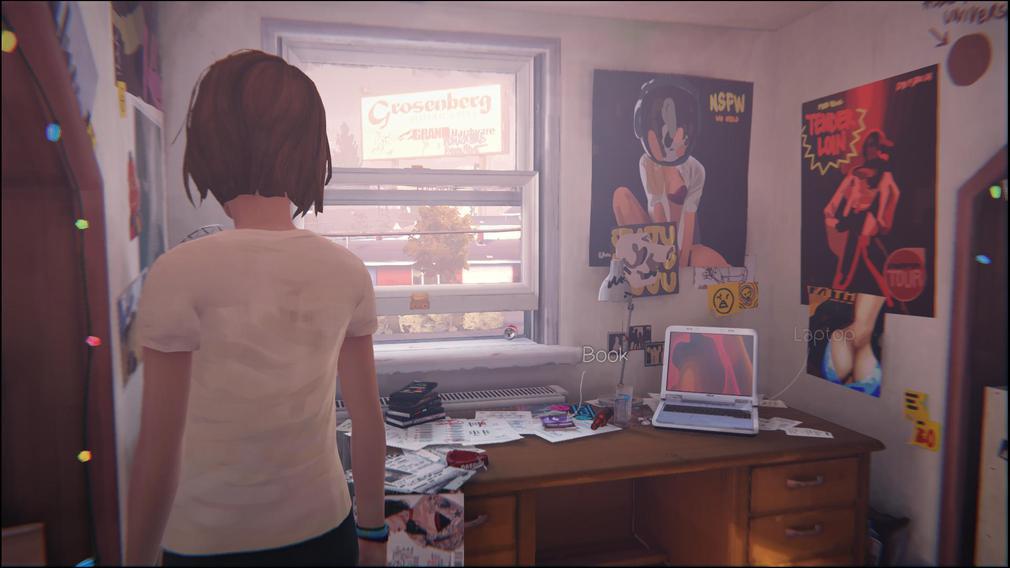
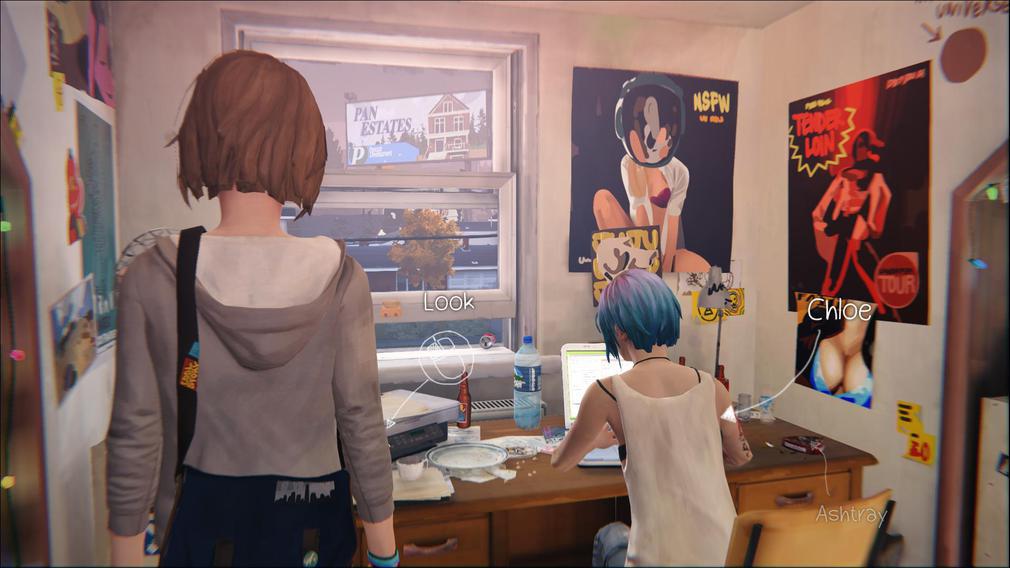
So these are actually two different timelines, only that the surrounding
is deceptive. We cannot conclude that everything in this timeline is
identical to those in the old one before Wednesday. Same reason
applies to all the time travels via photos. So in that
newly created timeline that starts from Monday, by staring that photo
in front that tornado, we could not tell if everything other
than Chloe's life was identical to the very beginning where things
were not disturbed by time travel at all, therefore we cannot
get any statistical regression conclusion. If we cannot provide adequate evidence
for the existence of the causal or statistical connection between two
things, we can only acknowledge the non-existence. For more details, see
the logically fallacious -Proving Non-Existence .
Continue the previous example. Today there comes a tornado, and I
rewind to five days ago via a photo, and avoid breaking
that cup, and I come back to see that tornado disappears.
Despite how happy I am, I still cannot say that the
cup is connected to the tornado, because I actually create a
new timeline that starts from five days ago, and I cannot
tell if everything other than that cup is identical to before
I rewind. Maybe the billboard outside my window changed too?
7. Some Other Thoughts
Some fatalism statements are no longer worthy, after playing Life is
Strange. The game keeps telling us "this action will have consequences".
I make different choice, and I will get (possibly) different consequences.
It's preferable to bother myself with how to make wise choices,
rather than to pay attention to the fate thing. Instead of
caring about whether I can succeed, I should care more about
how to succeed; instead of caring about whether I can get
a happy ending, I should care more about the process of
hardworking. If I blame my failure on fate, it's only finding
excuses for my inability or cowardice. Like the police officer said
in Two Whales Diner in Episode 2, "you have to create
your own good luck." If I don't try, failure is the
only ending. This is also why I very much love the
song The Sense Of Me. "Try, to try again" is the
best sum-up of the thing we all should do. Max tore
up the photo that would win the contest, despite her deep
love of photography. Max also sat on that driving seat and
headed back to town to find a way to save Chloe,
despite the dangerous road and that she was only a novice
driver. All these were eventually repaid by the reunion on the
beach, which may be the happiest moment I will ever get
in a video game. That's the perfect example of "the sense
of me". Also, there's a quote from the novel All Wounds:
"Well, yea, that's part of what I love about us, Chloe:
we try. We, like, inspire each other to try. I don't
expect our lives to magically become some happily-ever-after." (All Wounds, Chapter
20, A Song of Healing)
Very good are these words from George Bernard Shaw: "The people
who get on in this world are the people who get
up and look for the circumstances they want, and, if they
can't find them, make them." People don't need to trap themselves
in adverse surroundings, and keep complaining about the slings and arrows of
outrageous fortune, or the fault in crossed stars, while cringing away and
shrinking back from making own choices.
"Fate" and "destiny" and stuff are in fact telling people to
obey, and choices and trying are meaningless. However, the process of
making choice itself is the "meaning"; trying with the best effort
itself is happiness. William and Joyce cannot change the fact that
a paralyzed Chloe is suffering from a dying respiratory system and
will eventually die, no matter how hard they try. Does that
mean their trying is meaningless?
Chloe was abandoned, in the hardest time in her life, and
was left alone for five years. An unforgivable mistake to say
the least. People always say that tolerance is a virtue, now
I know they are not kidding. I love the book Tolerance
by Hendrik Willem van Loon, but until now those stories only
happened in history, not in my life. Then Chloe came and
showed me again, this time with personal experience and full details,
what a great virtue tolerance is. When Max came back to
Arcadia, Chloe chose to recognize the old Max as the closest
friend. She chose tolerance, and the choice eventually paid back with
survival and happiness. An incomparably wise choice to say also the
least. Russell said "Love is wise. Hatred is foolish." It sounds
just like some fancy words at first, but now I realize
there are more to it. I just need time to find
out what are more to it.
My only worrying is that the death of Joyce in that
tornado would damage Chloe so severely that she would never be
as strong as before, strong enough to see Max with no
grievance. And Max thought the tornado was caused by her action,
and buried herself so deep in remorse that there's no way
out. Maybe Chloe didn't want to become the reason of Max's
sorrow and helplessness, so she took out that photo, and asked
Max to rewind to Monday to save the town. It's only
that, when faced with difficulties, we should choose to overcome, not
to surrender. And more importantly, we cannot prove anything between Chloe's
life and that tornado. So remorse is only because of misunderstanding
of natural laws. To get rid of it, the only thing
Max should do is to make up her mind, oh-so determinedly,
to study deeply about meteorological physics.
8. A Word to Finalize
"The purpose of morality is to teach you, not to suffer
and die, but to enjoy yourself and live."
-- Ayn Rand

0 people liked this.



- @Rayotta Author